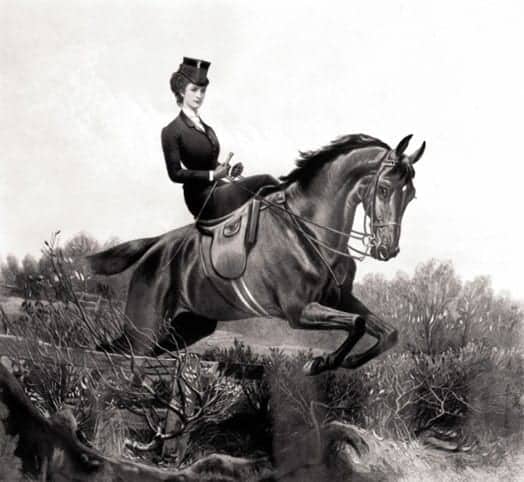
I invite you to delve into a beautiful and unknown story, in which you will learn how our mothers, grandmothers, etc., traveled on horseback for hundreds of years, and which, over time, became the riding style that distinguished women of high society. Currently, many art pieces show women riding sideways, and there are even pieces rescued from the Isle of Man that suggest it may have been practiced before 1000 AD.
For many years, it was difficult to find women on a saddle; it was not until well into the Middle Ages that they could be seen. When they managed to ride a horse, they did not do so alone; instead, they had to settle for riding behind a man's saddle, astride. They sat on a small back seat with padded reinforcement, not facing the wind, but practically sideways, "as mere passengers."
Medieval illustrations exist that show women when they began to ride alone; they did so seated, with their feet resting on the same side. Even so, this position meant they could not have full control over the horse and needed help to get on and off the equine. Therefore, they were often led by a man, who did so on foot or from another horse.

LET'S DELVE DEEPER INTO THIS TRADITION.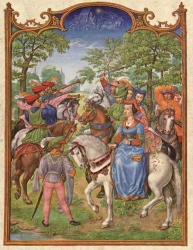
Throughout history, women have spent a large part of their lives pregnant, raising their offspring, and skirts and dresses were part of their usual attire. Due to all of this, riding astride was impossible. It is known that there was a belief that riding astride was detrimental to a woman's reproductive function, so the side-saddle position was the most suitable for traveling on horseback.
For a long time, "riding side-saddle" was considered the only way a woman could ride a horse. Readers might wonder, "What is riding side-saddle?" I'll explain: it is an old term referring to the position in which women rode in past times, which was with their legs placed to the same side.
Side-saddle riding developed in Europe partly due to the social customs of the wealthy classes, where it was dictated that it was immoral for a woman of high status and apparent good health to ride astride. Fashion demanded wearing long dresses or long skirts, so riding astride in such attire was sometimes impossible and undignified, potentially being considered immodest.
Let me tell you an anecdote: they had noticed that the Virgin Mary rode sideways. Below, in an image, we can see Mary with Jesus being led on foot by Saint Joseph, fleeing from Jerusalem to Egypt—a curious detail, isn't it! Similarly, in Spain in the sixties, our grandmothers rode sideways on Vespas, as it was frowned upon for them to do it any other way.
From the beginning, our ladies' saddles have evolved over time, offering safety and prominence to side-saddle riding. In the 9th century, a small planchette was added to the riding seat they used; later, new elements were added until the 14th century, when they received the well-known name "Jamuga." This saddle began to be adapted as a riding saddle to transport ladies on horseback, always with the help of a "groom" to guide them.
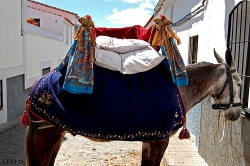
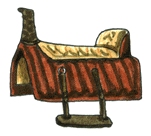
Between the 14th and 15th centuries, the jamuga improved, giving women more autonomy, but this was not enough; it still offered little control over the horse due to the difficulty of handling the reins, and ladies could not ride faster. Consequently, they could only show off during strolls. Because of this, the use of the "palfrey" became popular as a riding horse for ladies due to its small size and docility.
In the 15th century, Catherine de' Medici was considered the forerunner of several improvements to the side-saddle, which allowed the French Queen to have independent and complete control of the horse. Such was her ability that she went hunting with her husband and continued riding until she was over 60 years old.
These women's saddles were used throughout Europe, from which, in the interest of freedom of movement, the side-saddle with horns evolved, allowing women to be autonomous on horseback.
The side-saddle saw a great boom in European society in the 18th and 19th centuries, always linked to the wealthy classes; in our country, it did not become popular because only affluent people could afford it, unlike its predecessor, the jamuga, which was cheaper.
The jamuga and the horn saddle coexisted until the 18th century, when women could already be seen riding astride, and side-saddle riding began to be reserved for the upper classes.
From this moment, the jamuga was forgotten over time throughout Europe and much of Spain, surviving only in certain places and linked to specific festive and religious events.
Empress Elisabeth of Austria, Sisi, was one of the reasons women could ride side-saddle, as she promoted this type of riding due to her passion for horsemanship.